Mojeek Search Engine Review: Privacy and Features
Table of Contents
Mojeek search engine review
Mojeek is a UK-based private search engine with its own web crawler. It also runs an independent index and ranking system. This is uncommon among private search tools that source web links from other providers.
This matters to AI researchers because search results shape source discovery and evaluation datasets. Another index can expose pages a dominant system missed or ranked poorly. Mojeek also avoids user-level search tracking under its published policy.
Still, an independent index does not guarantee better answers. Coverage and ranking quality can vary by query. This review covers Mojeek’s technical design, privacy, ranking, features, UK context, research uses, and limits.
TL;DR: Mojeek combines search privacy with an independent search index powered by MojeekBot, although coverage and ranking quality vary by query. Main points include:
- MojeekBot and the independent web index
- Logging and cookie rules
- Lexical and semantic search features
- Operators and custom site collections
- Differences from four major alternatives
- Practical tests for AI research workflows
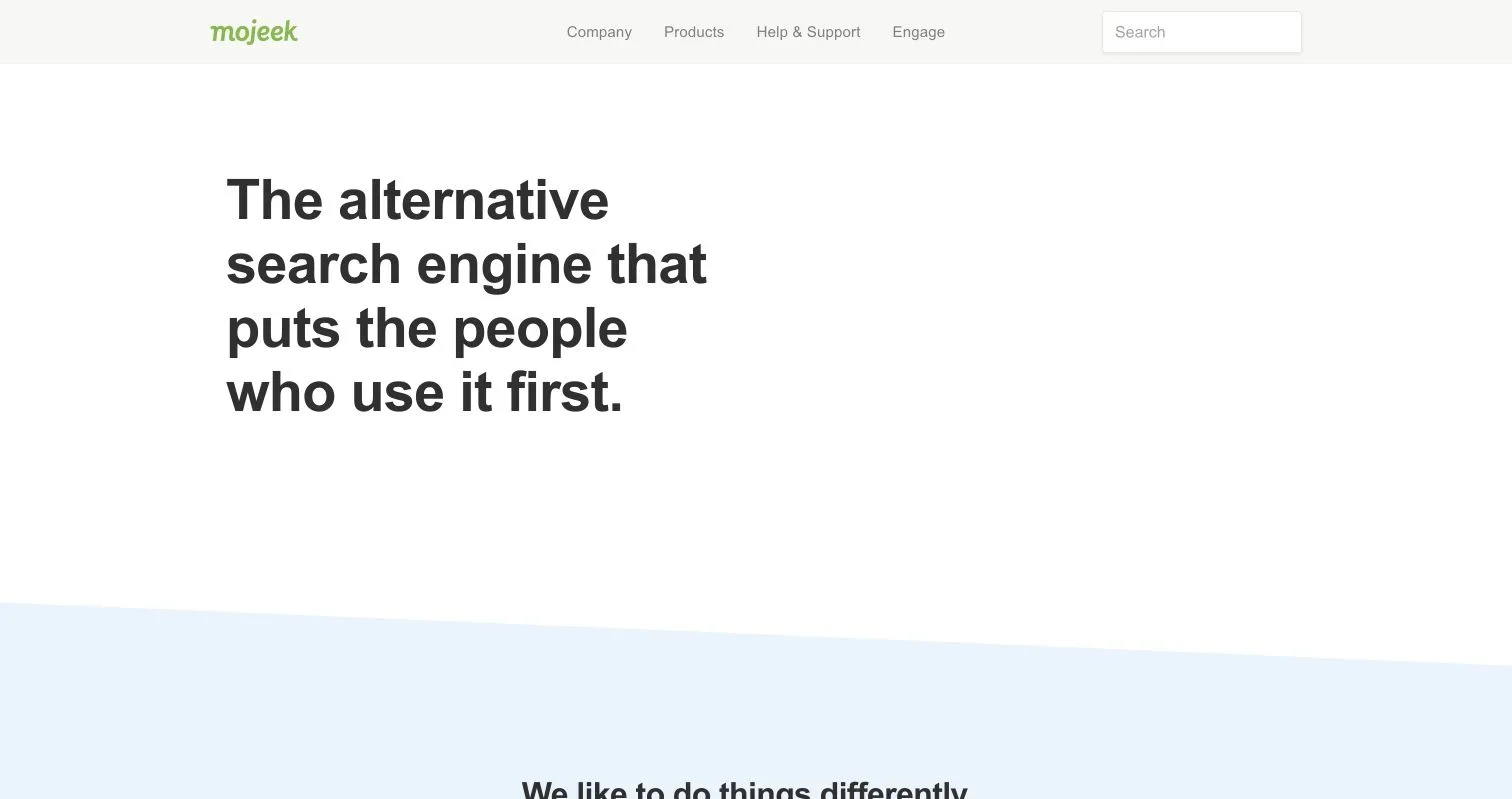
Source page reviewed in Chrome during article research. Follow the image link for the current page.
What is the Mojeek search engine and why does it exist?
Mojeek crawls and indexes public web pages, then ranks matching results.
The official Mojeek About page says the project started in 2004. The current timeline says its index passed 9 billion pages in 2025. This counts indexed pages, not unique domains or pages returned per query.
Mojeek Limited operates the service. The company is registered in England, and its About page lists an address in Brighton. Its UK base explains searches for Mojeek UK, though the engine supports international searches.
The company aims to provide search without user tracking or dependence on Google or Microsoft Bing.
That second aim affects research. A private interface can still return results from a large external index. Such a tool improves privacy without necessarily adding an independent discovery system.
Mojeek takes a different route:
- Crawling: MojeekBot discovers pages on the public web.
- Indexing: Mojeek stores and processes eligible HTML pages.
- Ranking: Mojeek applies its own algorithms to indexed URLs.
- Delivery: Search requests go to Mojeek rather than another web search provider.
- Infrastructure: The company says it manages its search infrastructure.
The company’s technology page says founder Marc Smith built the core technology from scratch. It says much of the technology uses C and that Mojeek owns its technology and intellectual property.
These remain company claims. Outsiders cannot inspect the full production index or ranking code. Researchers should treat the declared crawler and different results as evidence, not a full independent audit.
Mojeek’s independent search index and ranking
Mojeek’s independent index is the main reason to test it. The company says MojeekBot supplies its index and proprietary algorithms rank the results. Its independence explanation calls the web results 100 percent independent.
Mojeek mostly uses lexical matching. Its support guide says query words match text on indexed pages. This favors exact technical terms over conversational questions. Extra words may restrict matching without adding meaning.
A focused query may work better than a long request:
| Research need | Less focused query | Better test query |
|---|---|---|
| Find a model paper | who wrote the paper about sparse mixture models | sparse mixture model paper |
| Search one domain | pages about agents on arxiv | site:arxiv.org agents |
| Find recent material | new retrieval benchmark | since:month retrieval benchmark |
| Check title wording | pages with synthetic data in title | intitle:synthetic data |
| Exclude broad noise | general AI safety material | intext:AI safety with a site filter |
Mojeek added Semantic Search in 2024 according to its product timeline. It also added Search Summary in 2024. These features add modern query handling to a system still centered on lexical matching. Researchers should identify which interface element produced an answer; a generated summary differs from organic ranking.
The standard results interface offers several useful controls:
- Country-level location settings
- Preferred result language
- Safe Search
- News results beside web results
- Configurable title and snippet lengths
- Search Choices for repeating a query elsewhere
- An optional Wikipedia Infobox
Mojeek says country detection gives suitable regional pages a ranking boost. Users can set the country, while language selection boosts pages in that language. Users should match settings before attributing differences to ranking changes.
The company says people with the same country and language settings should receive the same ranking at the same time. It attributes this consistency to its lack of personal tracking, which supports reproducible collection. Yet exact reproducibility still requires recording the query text, date, location, language, Safe Search state, and interface type.
Mojeek reports that most queries return in under 300 milliseconds. It also reports a median response time of 88 milliseconds. These are provider measurements from its Why Mojeek page. They do not guarantee performance by user or region.
Mojeek search privacy and data handling
Mojeek’s privacy policy says it does not track individual users. It also says the service does not record IP addresses in its standard logs.
Mojeek replaces IP addresses with country codes but retains other log fields. Those fields may include the request time, requested page, referral data, and browser information. The company says it keeps standard logs indefinitely.
No tracking does not mean no operational data. Mojeek still retains non-identifying traffic information under its policy.
| Data or setting | Published Mojeek treatment | Research impact |
|---|---|---|
| IP address | Replaced with a country code | Reduces direct user identification in logs |
| Search and page logs | Kept without the IP address | Aggregate activity can remain available |
| Browser information | Stored in a separate log | Browser data still forms part of operations |
| Default cookies | Not placed without agreement | Basic search can work without preference cookies |
| Aggregate search data | May help improve results | Queries can affect system-level improvements |
| Contact details | Used for requested contact | Account or contact activity has separate data needs |
The Mojeek privacy policy says retained log data will not be sold or distributed to third-party vendors. It also says Mojeek may use aggregate non-personal search data to improve results.
Preferences add one wrinkle. Users can store settings in a cookie or use cookieless URL parameters. URL parameters aid reproducibility but can expose settings in copied URLs or browser history.
Mojeek Focus needs a cookie because it stores custom site collections in the browser. It requires no account, but clearing the cookie removes unbacked-up collections.
For sensitive research, take these steps:
- Read the current privacy policy before collecting data.
- Avoid placing private text or unpublished findings in any web query.
- Record whether cookies or URL-based preferences are active.
- Keep country and language settings fixed across test runs.
- Review the destination site’s policy after opening a result.
Mojeek’s privacy policy stops applying when a user leaves Mojeek. Result pages can load their operators’ trackers, so search and browsing privacy remain separate. A private search engine protects the query under its policy, not every destination.
Mojeek search features for AI researchers and developers
Mojeek supports operators that help with research collection. The official search operator guide documents site:, intitle:, inurl:, intext:, and inanchor:. It also supports since: and before: date controls.
Date filtering relies on available modification data and cannot replace a verified publication date. A page can change long after its original release.
Mojeek Focus is another useful feature. It creates a reusable search scope from selected websites. The current Focus documentation states these limits:
- Up to 10 saved Focus collections
- Up to 25 included sites per collection
- Up to 25 excluded sites per collection
- Names of up to 24 characters
- Cookie-based local storage
- JSON-style backup and restore data
Focus suits literature monitoring: researchers can track selected labs or standards bodies, developers can search approved documentation, and SEO analysts can inspect industry sites without the full index.
A careful research workflow looks like this:
- Define a stable query set before testing.
- Set one country and one result language.
- Run each query through normal web search.
- Repeat selected queries with
site:or Focus. - Save result URLs and visible rank positions.
- Record the collection time and settings.
- Compare recall against at least one other independent index.
- Open and verify each source before citing it.
Mojeek also offers a Web Search API and a Site Search API. The APIs provide structured results, but teams should review current documentation and commercial terms before production. Limits and prices can change.
The interface has practical limits. Mojeek says users can reach result number 1,000 when enough relevant matches exist. It says result counts are exact rather than estimated, though limited to Mojeek’s index and query logic.
Mojeek clusters pages from the same host, increasing domain variety but hiding some pages behind grouped results. Researchers measuring URL recall should expand groups or run a separate site: query.
Mojeek search engine limits and comparison with alternatives
An independent, smaller index may find different material while missing pages found by larger crawlers. Different results do not prove higher quality.
Mojeek says it indexes HTML web pages. Its content policy says it does not index images or videos. The interface provides image search through another source. The company timeline says it added Openverse as an image provider in 2023. Researchers must separate Mojeek’s organic coverage from other tabs.
| Search engine | Standard web result source | Privacy or ranking distinction | Best comparison use |
|---|---|---|---|
| Mojeek | Own crawler and index | No user-level tracking under its policy | Alternative discovery and repeatable ranking tests |
| Brave Search | Own independent index | Private search with optional ranking tools | Second independent-index comparison |
| DuckDuckGo | Traditional links largely from Bing | Proxies partner requests and adds several sources | Private multi-source search experience |
| Google Search | Google systems and index | Can personalize results through account activity | Broad baseline and feature comparison |
| Microsoft Bing | Microsoft systems and index | Integrated web and AI search features | Major-index baseline |
Brave states that Brave Search uses its own independent index. This makes Brave a more direct comparison than a Bing-based privacy layer.
DuckDuckGo says its traditional links and images are largely sourced from Bing. It also uses its own crawler and several other sources for specific features. DuckDuckGo provides privacy controls without a fully separate standard web index.
Google documents that search personalization can use activity. It also notes that location and language can change results without personal history. Controlled comparisons therefore require matching regional settings.
Mojeek has several likely limits for daily work:
- Long natural-language prompts may perform worse than compact terms.
- Local business queries may have less detail than larger search products.
- Image and video coverage does not come from its HTML index.
- Result ranking can feel unfamiliar to users trained by Google or Bing.
- Index coverage can vary across small sites and fast-changing pages.
- Provider claims about scale do not replace independent recall tests.
Mojeek suits AI researchers seeking another discovery path and developers wanting search without user profiles. SEO teams can check whether pages appear outside Google and Bing. Small businesses may like its privacy approach, but should test local relevance first.
It is unsuitable as the sole source for exhaustive research; use another index alongside it. The overlap and the gaps can both tell you something.
Conclusion
Mojeek is a UK-based crawler alternative valued for its independent index and ranking system. Its no-tracking policy also limits the user data tied to standard searches.
For AI research, Mojeek works best as an additional retrieval channel. MojeekBot and its independent index can expose different pages and reduce reliance on one ranking system. Focus, date operators, site filters, and APIs add practical research options.
Its coverage and relevance vary. Image results do not come from the core HTML index. Performance and index claims need independent testing. Use fixed settings, record each query, and compare results with another independent index.
Frequently Asked Questions
Is Mojeek a good replacement for Google or Bing?
Mojeek can be a useful alternative for private searches and discovering pages ranked differently by major engines. However, its coverage and relevance vary, so it is better used alongside another independent index for exhaustive or high-stakes research.
Does Mojeek track searches or store IP addresses?
Under its published policy, Mojeek does not track individual users and replaces IP addresses in standard logs with country codes. It still retains operational fields such as request times, requested pages, referral data, and browser information, so “no tracking” does not mean no data collection.
How can I get better search results from Mojeek?
Use compact, specific keywords instead of long conversational prompts. Operators such as site:, intitle:, intext:, since:, and before: can narrow results, while consistent country and language settings make comparisons more reliable.
What is Mojeek Focus, and when is it useful?
Mojeek Focus lets you create reusable searches limited to selected websites while excluding unwanted domains. It is practical for monitoring research labs, searching approved technical documentation, or tracking a defined group of industry sites, but its collections are stored locally in a cookie and should be backed up.
Are Mojeek search results reproducible?
Users with the same country and language settings should generally see the same ranking at the same time because Mojeek does not personalize results through user profiles. For a reproducible study, also record the exact query, date, Safe Search setting, interface type, and whether cookie- or URL-based preferences were used.
Does Mojeek independently index images and videos?
No. Mojeek’s core index covers HTML web pages, while image results may come from an external provider, and it does not maintain a comparable video index. Researchers should therefore distinguish standard web results from content shown in other search tabs.
How should AI researchers evaluate Mojeek?
Prepare a fixed query set, keep regional settings stable, and save result URLs, rankings, and collection times. Compare the findings with at least one other independent index, then open and verify every source before using it in a dataset, analysis, or citation.
Related Articles
Understanding MojeekBot: UK's Independent Search Crawler
Complete guide to MojeekBot covering UK origins, independent search indexing, functionality, and privacy-focused approach compared to alternatives.
Andi Search: AI Search Engine with Zero Ads & Full Privacy
Complete guide to Andi Search - the AI-powered search engine that blocks ads and protects privacy while providing direct answers to your questions.
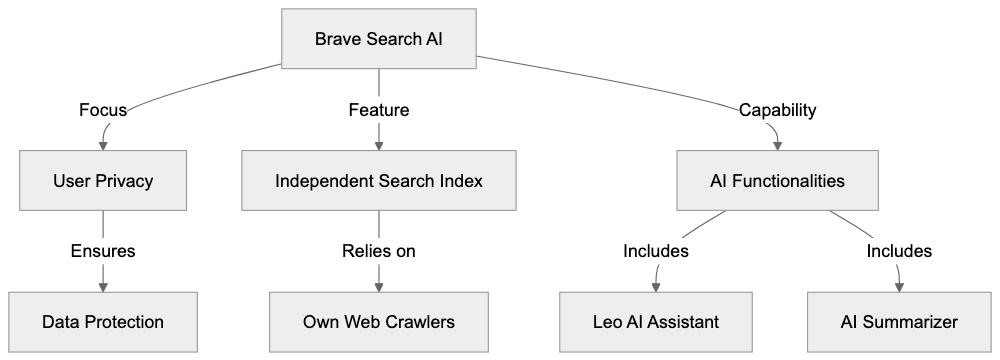
Brave Search AI Guide: Features, Privacy & Comparison (2024)
Learn about Brave Search AI's features, privacy-focused approach, and how it compares to other search engines. Detailed guide on its independent search index.